Can a fantasy novel become “Jewish” if someone eats a bagel in it?
That question, posed half-jokingly during a recent Jewish YA literature panel, sent the room into laughter. But beneath the joke sat a serious conversation about who gets to define Jewish storytelling in modern publishing.
At a moment when Jewish young adult literature is grappling with questions of identity, representation, and shrinking publishing support, a group of prominent Jewish YA authors gathered to argue for something larger than visibility alone: the right for Jewish stories to be messy, fantastical, queer, historical, funny, and fully human.
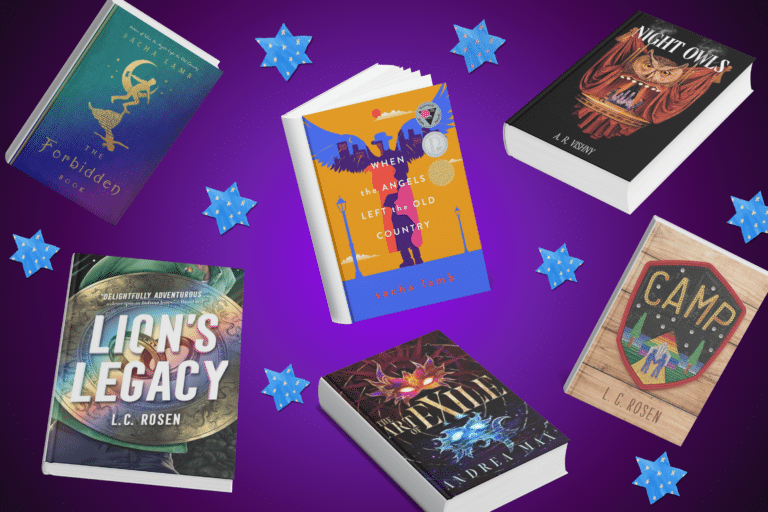
During a panel hosted at New York Comic Con, authors Sacha Lamb, Lev A.C. Rosen, A.R. Vishny, and Andrea Max spoke candidly about the tensions shaping Jewish young adult literature today: the pressure to avoid antisemitic stereotypes, the dominance of Holocaust narratives in classrooms, the challenge of writing queer Jewish characters, and growing fears that publishers are backing away from explicitly Jewish YA fiction altogether.

The audience frequently broke into laughter as the panelists bounced between literary theory, Jewish theology, fantasy tropes, and self-deprecating jokes about vampires, bagels, and Talmudic demons. But the conversation repeatedly circled back to a shared concern: despite a recent wave of critically acclaimed Jewish YA novels, many fear the market for explicitly Jewish teen fiction may already be contracting.
“There’s not much Jewish YA coming out next year,” Vishny, who wrote the YA estrie novel “Night Owls” said during the discussion. “It’s actually really bad.”
What defines “Jewish” in literature
For many of the panelists, the conversation began with a deceptively simple question: what actually makes a book Jewish?
The answers were anything but straightforward.
“A book is Jewish if you say it is,” Rosen said, reflecting on his own uncertainty about whether some of his fantasy work “counts” as Jewish fiction.
That uncertainty became a recurring theme throughout the panel. The authors described constantly negotiating the line between explicit Jewish representation and stories more subtly shaped by Jewish history, culture, language, or worldview.
Lamb, whose novel “When the Angels Left the Old Country” won both the Stonewall and Sydney Taylor Book Awards, often draws heavily from Jewish history and theology. They described struggling with whether a fantasy novel inspired by Jewish experiences but stripped of explicitly Jewish terminology still qualifies as a “Jewish book.”
The debate soon spiraled into fantasy worldbuilding and literary canon. Rosen joked that while C.S. Lewis’ “Narnia” series includes Turkish delight, “no one has a bagel in Narnia,” prompting laughter from the audience as the panelists riffed on whether a single bagel could transform a fantasy world into an Ashkenazi Jewish text.
But beneath the humor sat a larger frustration: several writers argued that Jewish literature is often held to standards of cultural explicitness that other identity-based fiction is not.
Rosen noted that books are frequently categorized as “queer” simply because they feature queer protagonists, while Jewish fiction is often expected to visibly perform its Jewishness through ritual, language, trauma, or religious observance.

“That struggle for what on earth it means [to be] Jewish,” Max said, “is something any Jewish author is going through.”
Several authors argued that Jewish YA fiction has increasingly become a vehicle for presenting Jewish identity not as singular or fixed, but as layered, contradictory, and evolving.
For Vishny, Jewish themes often emerge less through explicit religious struggle than through metaphor, fantasy, and inherited trauma. In discussing one of her vampire characters, she described supernatural elements as ways of literalizing intergenerational wounds and antisemitism while still telling emotionally grounded coming-of-age stories.
The authors emphasized that Jewish YA literature is no longer confined to a single narrative. It can contain demons, queer romance, Talmudic angels, secret societies, fantasy kingdoms, and centuries-old vampires, all while remaining recognizably Jewish.
Jewish stories beyond trauma
History quickly emerged as another defining thread in the discussion.
Across fantasy novels, paranormal adventures, and queer coming-of-age stories, the panelists described Jewish history not as background material, but as a framework shaping how they understand identity itself.
“For a lot of Jews,” Vishny said, “we understand our own Jewish identities through history.”
Several authors argued that mainstream publishing and education have often reduced Jewish historical narratives to an overly narrow set of stories, particularly Holocaust fiction aimed at younger readers.
“When I was young,” Lamb said, “most of the historical fiction … was a very sort of narrow range of Holocaust narratives.”

Lamb said one of their goals as a writer is to expose younger readers to the broader scope of Jewish history: immigration stories, political disagreements within Jewish communities, Sephardic experiences, folklore, mysticism, and Jewish life outside the familiar frameworks of persecution and genocide.
Other panelists pointed to what they viewed as a deeper educational gap. Max recalled being surprised during the editing process of her novel to discover that non-Jewish readers, including people in publishing, often lacked basic historical context about events like the Spanish Inquisition or Jewish exile.
Rosen described something similar from his own life. After telling someone his name was Hebrew, he recalled being told Judaism sounded “exotic,” only to realize the person had grown up with virtually no exposure to Jewish life at all.
“You probably know all the negative stereotypes,” Rosen said. “But you don’t know that they were associated with banking because literally the only job we were allowed to do in many countries.”
That disconnect, several authors suggested, has consequences not only for literature but for how Jewish identity itself is understood by wider audiences.


“You can be queer in a Jewish way”
The panelists also repeatedly returned to another theme shaping modern Jewish YA fiction: the intersection between Jewish identity and queerness.
For several of the authors, young adult literature offers a particularly powerful space to explore that overlap because YA stories are so often centered on self-definition, belonging, and the struggle to reconcile competing parts of identity.

“With ‘When the Angels Left the Old Country,’ it’s very much a story in which a character is discovering their queer identity through a very specifically Jewish Talmudic religious kind of vocabulary,” Lamb said.
Lamb explained that they intentionally wanted to challenge the assumption that queerness and traditional Judaism must exist in tension with one another.
“I wanted to make kind of a bold statement that you can be queer in a Jewish way,” they said, “and that you don’t have to give up everything about traditional Judaism to be queer.”
Rosen, author of the queer YA historical fantasy “Tennessee Russo” series, echoed that sentiment, describing how his own teenage years involved simultaneously navigating queer identity and Orthodox Jewish spaces. That experience later shaped his fiction, particularly stories centered on characters wrestling with questions of community and historical ownership.
“Who gets that more?” Rosen said of queer and Jewish history. “Which community do I belong to? Because it often felt like I was being forced to choose.”
Publishing Jewish stories
Despite the excitement surrounding the recent wave of Jewish YA fiction, many of the panelists spoke openly about the anxieties that still accompany writing visibly Jewish stories in mainstream publishing.
Several described feeling pressure, both internal and external, to avoid accidentally reinforcing antisemitic stereotypes, especially when writing fantasy, magic systems, secret societies, or stories involving power and hidden knowledge.
Max said she worried while writing her fantasy novel “The Academy of Muses” that certain themes could unintentionally echo antisemitic conspiracies, even when none of the characters themselves were Jewish.

“This is a book about secret societies, and there’s some blood consumption, and there’s people pulling puppet strings behind the scenes,” she said. “Finding that balance … without accidentally leaning into those tropes was a very difficult struggle.”
Lamb described similar concerns while writing Jewish fantasy characters that intentionally engaged with historical antisemitic imagery.
“There’s so much internal pressure not to represent us badly,” Lamb said.
At the same time, several panelists noted that Jewish creators often find themselves navigating a contradictory publishing landscape: one where Jewish gatekeepers remain present in the industry, but where explicitly Jewish stories can still be treated as risky, niche, or difficult to market.
Vishny recalled assuming editors would eventually ask her to make her novel “less Jewish,” even though that moment never ultimately came.
Others described more direct frustrations. Rosen said he once attempted to sell a novel about the 43 Group, the post-World War II Jewish anti-fascist organization in Britain that physically confronted neo-Nazi groups in the streets of London, only to be told the manuscript was “too angry and violent.”
The conversation also touched on what several writers viewed as the publishing industry’s long-standing tendency to prioritize Jewish suffering over Jewish complexity. Multiple panelists noted that while Holocaust fiction remains important, publishers and educators have often favored narratives centered on victimhood or non-Jewish “saviors” rather than stories emphasizing Jewish agency, resistance, or everyday life.
Is the golden age of Jewish YA ending?
By the final audience questions, the panel had drifted from bagels in Narnia to medieval antisemitism, Jewish vampires, Soviet memoirs, and the economics of YA publishing.
Again and again, the authors stressed that Jewish YA literature is not simply about representation for representation’s sake. For many young readers, they said, these books provide the first opportunity to encounter Jewish identity as expansive, contemporary, and emotionally complex rather than exclusively historical or tragic.
Yet despite the enthusiasm in the room, several panelists warned that the momentum behind Jewish YA may already be slowing. The panelists repeatedly encouraged readers to actively support Jewish literature, particularly stories that move beyond the narrow narratives many of them grew up with.
“We had a moment of amazing Jewish YA,” Andrea Max said. “And I really hope we’re gonna see more.”
For the authors onstage, the larger question was whether Jewish YA will continue to have room for stories that are strange, political, funny, romantic, angry, religious, queer, and unapologetically specific.